
Lyndhurst Previous Residents by Era
Use an era to choose the starting source. The strongest recent title trail is the County Clerk’s online index, while a much older address needs regional directory volumes, archival deed material, or local newspapers. Previous residents are time-bound entries. A directory listing, a probate file, and a recorded deed play different roles in the same address history.
| Source | Years It Covers | Where Held | What It Shows |
|---|---|---|---|
| Bergen County Clerk land index | 1970–present online | County Clerk Land Records Search | Recorded deeds, mortgages, parties, and instrument trail. |
| Passaic and Richmond directories | 1897–1899; 1909–1926 listed runs | New Jersey State Library inventory | Regional resident or business address listings when the volume includes Lyndhurst. |
| The Leader | 1928–2010 | Lyndhurst Digital Archives | Notices, family names, addresses, and local events to corroborate a period. |
| Federal census and archival material | Released schedules; recent decades remain closed | Archives and library research routes | Household and street context for its census date. |
| Older deeds and county collections | Before the online index | State Archives and Bergen history collections | Earlier recorded-property clues, subject to collection limits. |
Start with the parcel and a recent instrument when the address is known today. Start with a directory title, newspaper year, or archival reference when the question predates the online index. Keep the source’s own label, including “Lyndhurst Township,” rather than silently replacing it with a modern term.
Lyndhurst Past Residents Start With Place
Fix the address before attaching names. Record the current situs, block, lot, qualifier, parcel ID, and any unit shown in the tax record. The owner mailing address can be somewhere else. New Jersey MOD-IV guidance distinguishes that mailing field from the physical Property Location, so the physical parcel should control the starting point for a Lyndhurst previous-residents timeline.
Then preserve the historical spelling and number exactly as printed. A lot can be subdivided or merged, a street number may need more evidence, and regional directories can be filed under Rutherford or Passaic even when their coverage line includes Lyndhurst. No official complete local renumbering schedule was located, so a changed number is a question to investigate, not an established renumbering.
Lyndhurst Deed Chain for Past Residents
The Bergen County Land Records Search covers deeds and mortgages from January 1, 1970 forward in its online index. It is the core title route for later Lyndhurst previous residents, but the first task is to identify the latest relevant recorded transfer, not to assume that today’s tax owner describes every earlier period.
- Use the Bergen Property Record Search to record the physical location, block, lot, qualifier, and apparent owner shown for the parcel.
- Find the apparent owner’s purchase as a grantee in the Clerk index. Copy the grantor, grantee, recording date, document type, instrument or book-and-page reference, and legal description where displayed.
- Search the prior grantor as the next grantee candidate. Test exact and variant spellings, initials, married or former names, and estate, trustee, or corporate forms when the index supports them.
- At each step, compare the legal description and parcel identifiers. A matching surname is not enough if a lot changed or the instrument points to a larger tract.
- Use mortgages and satisfactions only as corroboration. A mortgage is not ownership, and a satisfaction does not prove a transfer.
- When the trail reaches the online boundary, keep the book, page, or instrument reference for the archival route rather than guessing a prior owner.
- Grantor
- The party transferring an interest in a recorded instrument.
- Grantee
- The party receiving that interest. Following a prior grantor as a later grantee is a common way to continue backward.
- Chain of title
- The sequence of recorded transfers connected by the same parcel or legal description, not merely a list of similar names.
- Legal description
- The land description in the instrument. It can be more stable than a street address when numbers, lots, or municipal labels change.
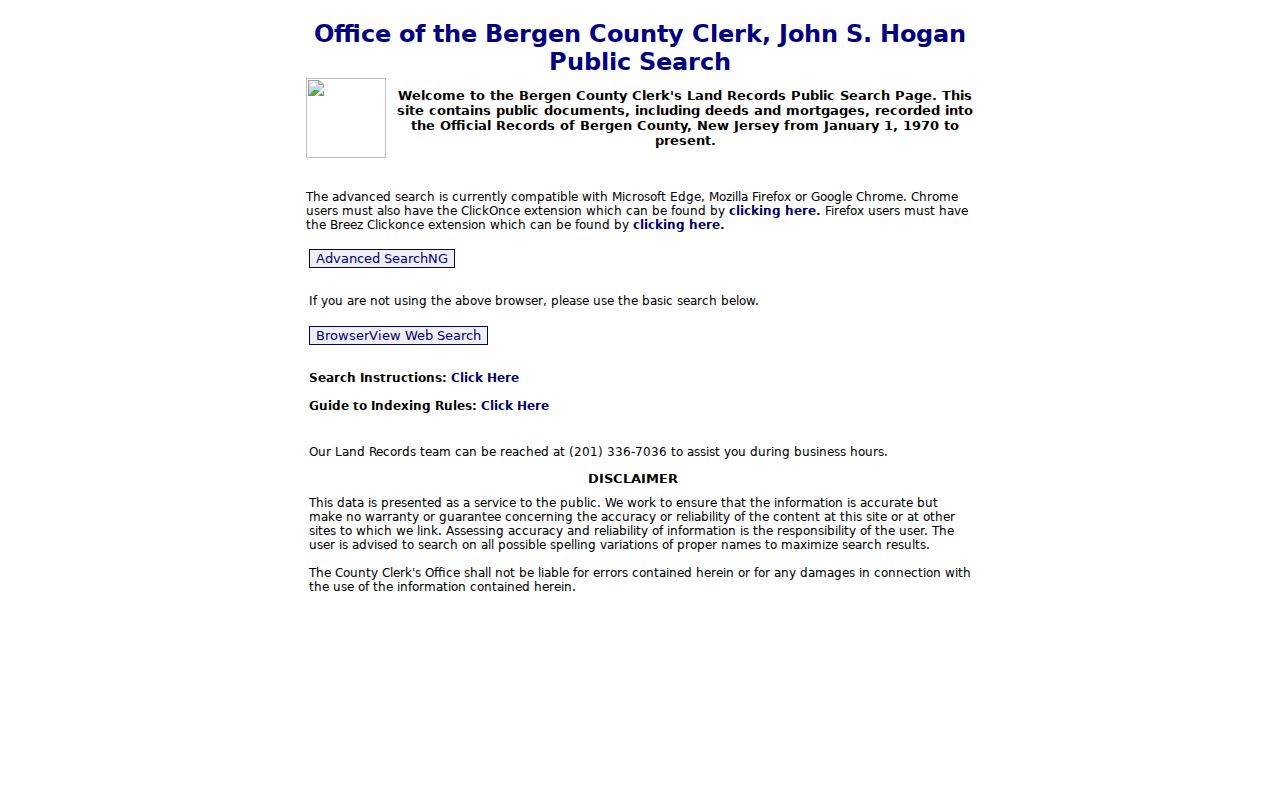
The Clerk’s official landing screen provides browser compatibility guidance and a basic-search fallback.
A title-chain result should be labeled as recorded ownership evidence. It is not a direct statement of who was physically present at a property on every date.
Lyndhurst Deeds Before the Online Index
For a pre-1970 transfer, move to the New Jersey State Archives genealogical collections and the county’s historical research routes. The research identifies county-deed microfilm through 1900 at the Archives and Bergen County History Archives miscellaneous deeds for 1783–1948. These are sources to consult or request, not proof that every Lyndhurst address has a complete digitized file.
County records may use a different municipal or historic naming convention. Preserve the name on the source, the book/page or film reference, the date, and the parcel language. The Clerk can be the later confirmation route when a clear instrument citation emerges. Older research often requires an archive inquiry, a collection search, or a visit rather than an online name box.
Note: The County Clerk’s online start date marks an index-access boundary, not the beginning of Bergen County property records.
Lyndhurst Previous Residents, Directories First
The New Jersey State Library directory finding aid lists regional volumes that explicitly cover Lyndhurst. The Passaic Directory covers 1897–1899. Richmond’s Rutherford-area directories list Lyndhurst for 1909–1914, 1917–1924, and 1926, while the 1915–1916 title does not name Lyndhurst and needs volume-level verification. The 1917–1924 runs use “Lyndhurst Township,” a useful original label for notes.
- Choose the directory volume closest to the date in question, then record its title, year, reel or book reference, and coverage wording.
- Read the address section first if the volume contains one, then compare the alphabetical section for the same surname and number.
- Pair a directory observation with the nearest released federal census schedule, comparing street, house number, age, occupation, and household composition.
- Label a directory entry as listed and a census result as a household snapshot for that census date. Neither establishes title without the recorded-property trail.
The directory runs and their catalog details belong in the Lyndhurst city directory collections; here they serve as one dated layer in an address timeline. The Lyndhurst Public Library Research & Learning page provides catalog and licensed-database routes, but its public pages do not list a dedicated Lyndhurst reverse-directory shelf or obituary index. Ask about a specific volume, microfilm, newspaper, or database rather than assuming a house-history collection exists. A disappearance from a volume can reflect non-inclusion, a spelling difference, a scope change, or death. It is not automatic evidence of a move.
Lyndhurst Past Residents in The Leader
The Lyndhurst Digital Archives offers keyword searching of The Leader from 1928 through 2010. Search a surname, an initial, the street, a neighboring family name, and a year. Read the newspaper page in context because OCR can split names and notices can be incomplete or ambiguous. The paper may add a date, relationship, community event, or address clue that helps distinguish two similar names.
The 1915 Sanborn sheets for Lyndhurst and Kingsland are another context layer. They can show a street layout, building footprint, use, construction material, and nearby landmark, but they do not identify ordinary residents. Compare a Sanborn clue with a directory, deed, or tax-map citation rather than treating it as a person record.
Lyndhurst Names, Estates, and Probate
Search name variants through every era. Directory entries may use surname-first order, initials, a married or former name, a business form, or an older municipal label. Record each version rather than silently combining them. The same care applies to a grantor, grantee, occupant, listed resident, or estate. Each is a role printed by a particular source, not a conclusion that the person had every connection to the property.
The Bergen County Surrogate maintains wills back to 1714. A probate matter can explain why an estate or fiduciary appears in the title trail, especially when a later deed follows an estate event. Probate is a bridge, not a deed substitute. The recorded instrument and its legal description remain the evidence for a transfer of the parcel.
The Lyndhurst Historical Society can provide local context, photographs, oral-history leads, or building-name background. It should not be treated as a complete private-house register or an official current index.
Lyndhurst Previous Residents, Original Labels
Record the place name exactly as the source prints it. Older research may appear under Lyndhurst, Lyndhurst Township, Kingsland, a Rutherford-area title, or a Passaic-area title. Lyndhurst Township was established in 1917, which helps explain the “Lyndhurst Township” wording in the 1917–1924 Richmond directory runs. It does not authorize changing an earlier or later source label to fit a modern search form.
The same catalog caution applies to the Newberry cross-reference, which lists Lyndhurst entries for 1923–1924 and 1928–1929 under Rutherford. Use the title, coverage line, year, and reel or book reference in the address timeline. A regional catalog heading can lead to a volume that covers Lyndhurst, but it does not by itself prove an address entry on an uninspected page.
When a spelling, number, or municipal label changes, compare the deed’s legal description, the directory street section, the Sanborn context, and later tax-map information. Preserve the question if those sources do not yet connect.
Lyndhurst Previous Residents, Confidence Labels
Build one address timeline with the date or year, source type, person or entity exactly as printed, role, address exactly as printed, parcel or block-and-lot when shown, instrument or page citation, confidence, and unresolved question. Use “directly shown” for a clear source statement, “corroborated” when independent sources agree, “probable match” when facts align but remain incomplete, and “unresolved” when the evidence conflicts or is too thin.
Do not use a current tax owner to rewrite an older directory entry. Do not use a directory absence to state that a property was vacant. An obituary can lead to a newspaper page, vital record, or probate file, but it is not the certificate or the deed. Those distinctions keep a Lyndhurst previous-residents record trail useful for family and place history without overstating what it proves.
Lawful use. Use house-history and family-history records with care. Never use a timeline to stalk, harass, or attempt to locate a living person, and never work around a protected address or an official redaction.