
Lyndhurst Resident Lookup Record Coverage
No authoritative, complete current list of Lyndhurst residents was located. A useful result answers a narrower question, such as who is listed as a parcel owner, whether a supplied name appears in a court matter, or whether an older directory placed a household at an address. Treat each result as a dated record, not a profile. The most dependable approach compares two independent record families and labels the result by what the record actually says.
| Record | What It Confirms | Where | Access |
|---|---|---|---|
| Property roll | Assessed owner, parcel location, block, lot, and qualifier, not an occupant | Bergen Property Record Search | County-linked public portal; recent transfers can lag |
| Deed index | Recorded party and instrument trail | Bergen County Land Records Search | Online index from January 1, 1970 forward; older work is archival |
| Court case result | Party, venue, docket, caption, and initiation date | New Jersey Courts public search | Public metadata varies by case and document restrictions apply |
| Voter record | Registration data where the law allows it | State status route or a Bergen County written request | Protected fields and addresses are withheld |
| Vital or historical record | Event relationship or a past listing | Lyndhurst Registrar, NJDOH, State Library, and local archives | Eligibility, age windows, and collection rules apply |
Start with property when the question is about ownership, with the court portal when a docket number is known, and with a dated directory or newspaper when the person belongs to an earlier period. An owner mailing address may be elsewhere, so compare the portal's property location, also called the situs, with the parcel and recorded instrument before describing any connection to Lyndhurst.
Start a Lyndhurst Resident Lookup
Begin with identifiers already tied to the question: the complete name, a spelling variant, an approximate year, a known street, and Lyndhurst as the municipality. Do not guess an address from a name alone. Keep middle initials, former names, suffixes, and surname-first directory forms in the search notes. A no-result is still a result, especially when the source has a limited date range or a protected record.
- Use the narrowest official source first. For a supplied property address, search the tax portal by location and retain the block, lot, and qualifier. For a known case, use the docket or party route.
- Record the source date and label the observation. A property record can be recorded or current to a tax-list cycle, while a directory can be historical and a voter entry can be registered.
- Verify through a different record family. Compare an apparent owner with the deed index, a historical directory entry with a newspaper page, or a court party with the case jacket.
- Resolve similar names only with a second identifier, such as a street, middle initial, age range, household clue, or entity relationship. Stop once the requested fact is supported.
Separate Lyndhurst Owner and Occupant
The Bergen property portal is a practical owner-name entry point, but the New Jersey MOD-IV field structure separates an owner mailing address from the physical property location. That distinction matters in every Lyndhurst resident lookup. A name linked to an assessment record can establish an owner or mailing clue, not who is living at the location now. A qualified unit can also share a street number with other records.
Copy the property location, block, lot, and qualifier, then compare the parcel in the County viewer and the recorded party in the Clerk index. The County's online land-record index covers deeds and mortgages from January 1, 1970 forward. For earlier title research, preserve the book, page, instrument, or film reference for the State Archives or a county records inquiry. A deed proves a recorded transaction, not continuing occupancy.
Note: The tax portal warns that recent sales after the latest June 30 may not yet be finalized.
Verify a Lyndhurst Resident Court Result
The statewide court search is useful when a party name or docket is already known. It is not a Lyndhurst address database. The official Case Jacket training example uses a case-type selection, docket, party-name, and judgment tabs, an individual or business choice, last and first name fields, optional middle initial, and a search button. In the individual example, two characters or fewer search exactly, while three or more allow broader matching.
| Party name | The name returned by the selected search mode |
|---|---|
| Venue | The court location or jurisdiction, not a residence field |
| Docket number | The case identifier used to open the case jacket or request a copy |
| Case caption | The case title, which needs context before interpretation |
| Case initiation date | When the matter began, not a final outcome or current status |
- Docket
- A court's identifying number for one matter.
- Index versus image
- An index gives searchable metadata. An image is the underlying document, and it may be unavailable or restricted even when the index is public.
- Certified copy
- A copy issued and authenticated by the custodian for the purpose allowed by that office. It is different from a search result.
For a document, use the New Jersey Courts records-copy route with the court, case number, and document identified. Municipal matters have a local route through Lyndhurst Municipal Court, while family and other protected records can have party, attorney, or confidentiality limits. A venue or caption never establishes a party's Lyndhurst residence or outcome.
Check a Lyndhurst Resident Voter Record
New Jersey law makes some registry-list fields available, including name, address, date of birth, party affiliation, and voting history, but it protects signatures, Social Security numbers, driver identifiers, and covered addresses. A voter entry shows registration information for an election. It does not prove title, current occupancy, or a complete identity match. A voter can be inactive, registered at an earlier address, or protected.
The official New Jersey voter-status service is illustrated below.
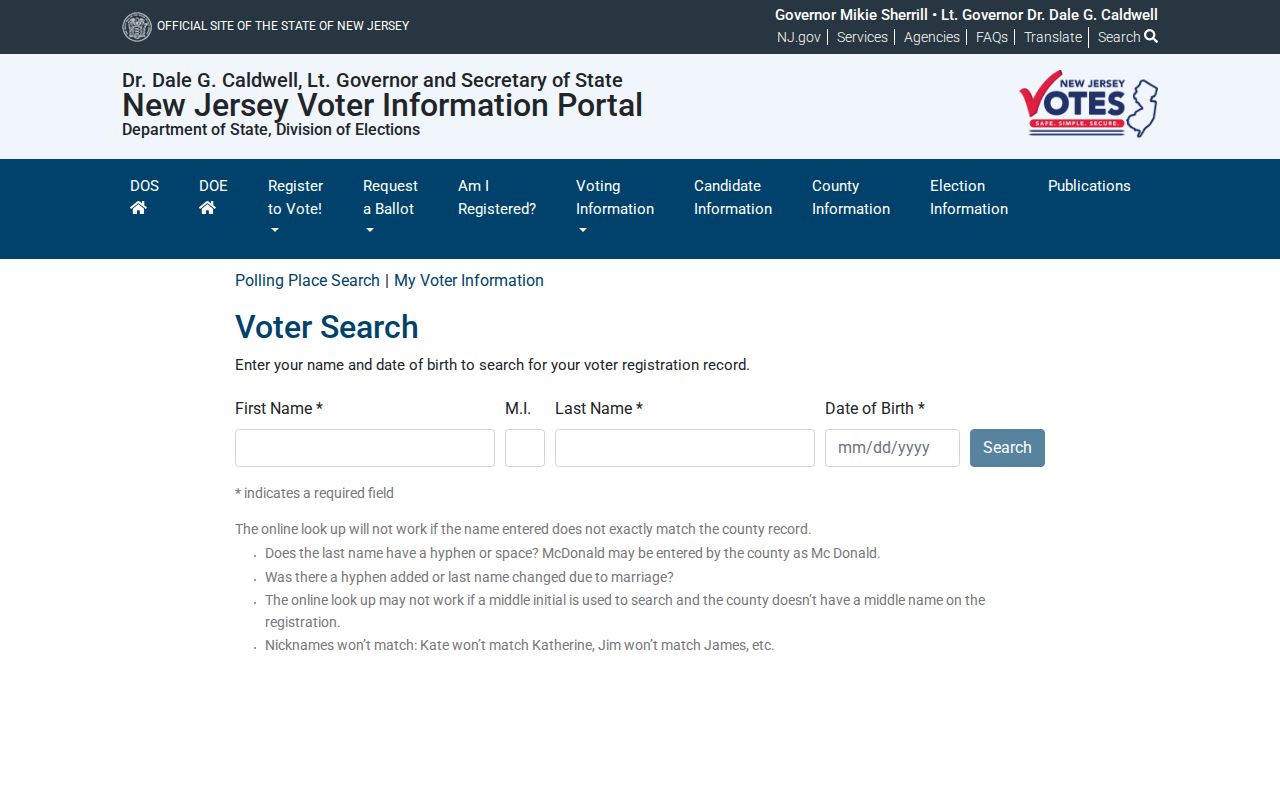
The capture documents the state route, but the unattended review did not expose final form fields or results. It should not be described as an unrestricted third-party name search. For a list request, use the Bergen County election offices and name the election district and date. State guidance lists printed voter copies at $0.25 per election district, subject to request and privacy rules.
Use Lyndhurst Resident Vital Records Narrowly
Vital records can confirm an event or family relationship, not a continuing address. The Lyndhurst Registrar at the Municipal Annex issues certified copies for events that occurred in Lyndhurst. For an event elsewhere, use the municipality or the State Office of Vital Statistics and Registry that holds it. Recent certified copies require the eligible relationship, legal authority, identification, and other proof described by the custodian.
For family-history work, the state's genealogical route generally opens births after 80 years, marriages after 50 years, and deaths after 40 years. The NJDOH genealogical-record guidance calls for a full name, city or county, and year, with further details when known. An informational genealogical copy does not prove identity or a legal relationship. For an older Lyndhurst name, test the event details against directories and newspapers rather than treating a single event record as a residence record.
Trace a Historic Lyndhurst Resident
Historical evidence is strongest when its period is stated. The State Library's directory inventory lists Rutherford-area volumes that explicitly include Lyndhurst in 1909 through 1924 and again in 1926. A regional heading is a catalog clue, not a municipal change. Read the title page and coverage statement before connecting a name to an address. The State Library directory inventory is the source for those runs.
Then use Lyndhurst Digital Archives for The Leader, which covers 1928 through 2010. Search a surname, street, or year, then inspect the full page and nearby columns. A printed directory can name a household head, business, boarder, or subscriber, while a newspaper mention may report an event rather than an address. The historical volumes are expanded in the Lyndhurst city directories; use them as one dated layer in a one-person verification trail.
Read Narrow Official Results Properly
A credential, a correctional record, and an offender-registry result serve distinct official purposes. None is a general resident proof. Use the exact system only when its stated purpose matches a legitimate question, and do not turn a name match into a statement about where a person lives or their character.
The New Jersey Consumer Affairs License Verification entry point is shown below.
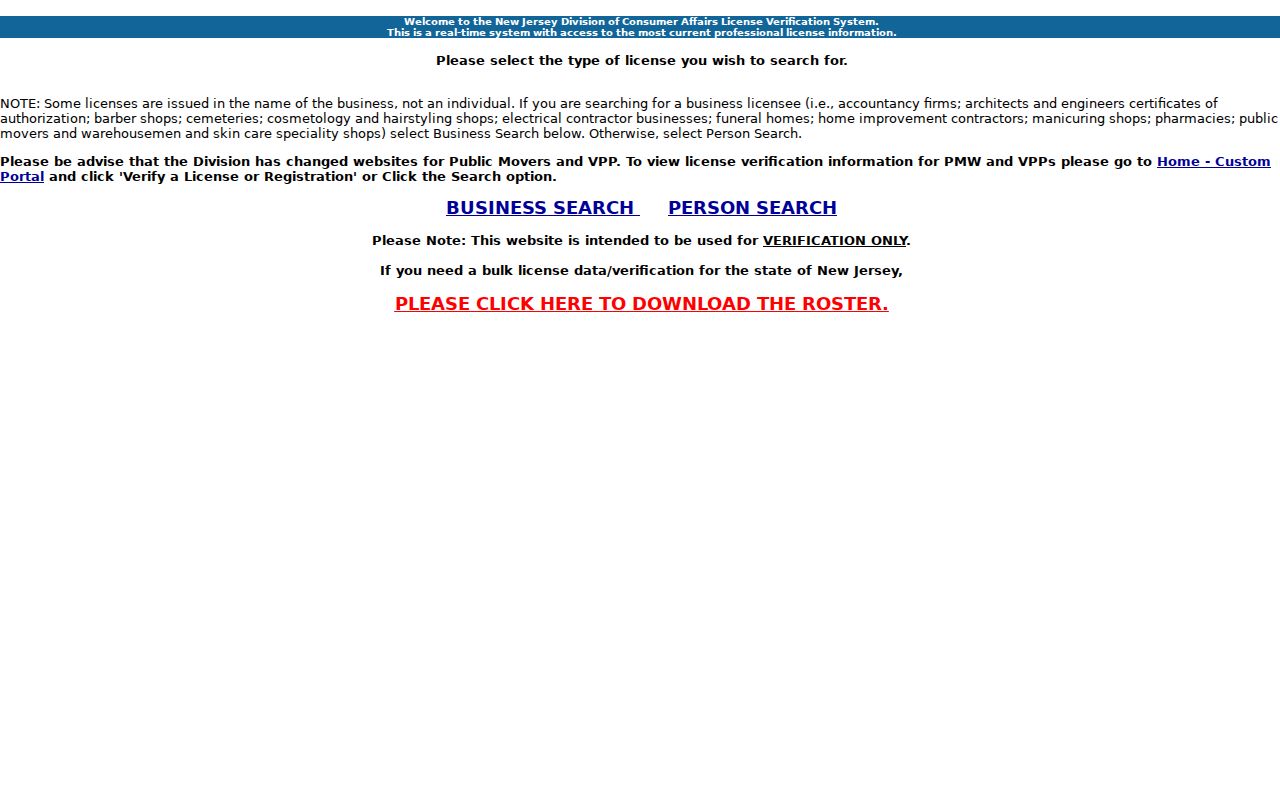
It asks the user to choose a license type and then a business or person search, with fields varying by board. It can verify a credential connection. It cannot establish Lyndhurst residence.
The New Jersey Department of Corrections Offender Information entry point is shown below.
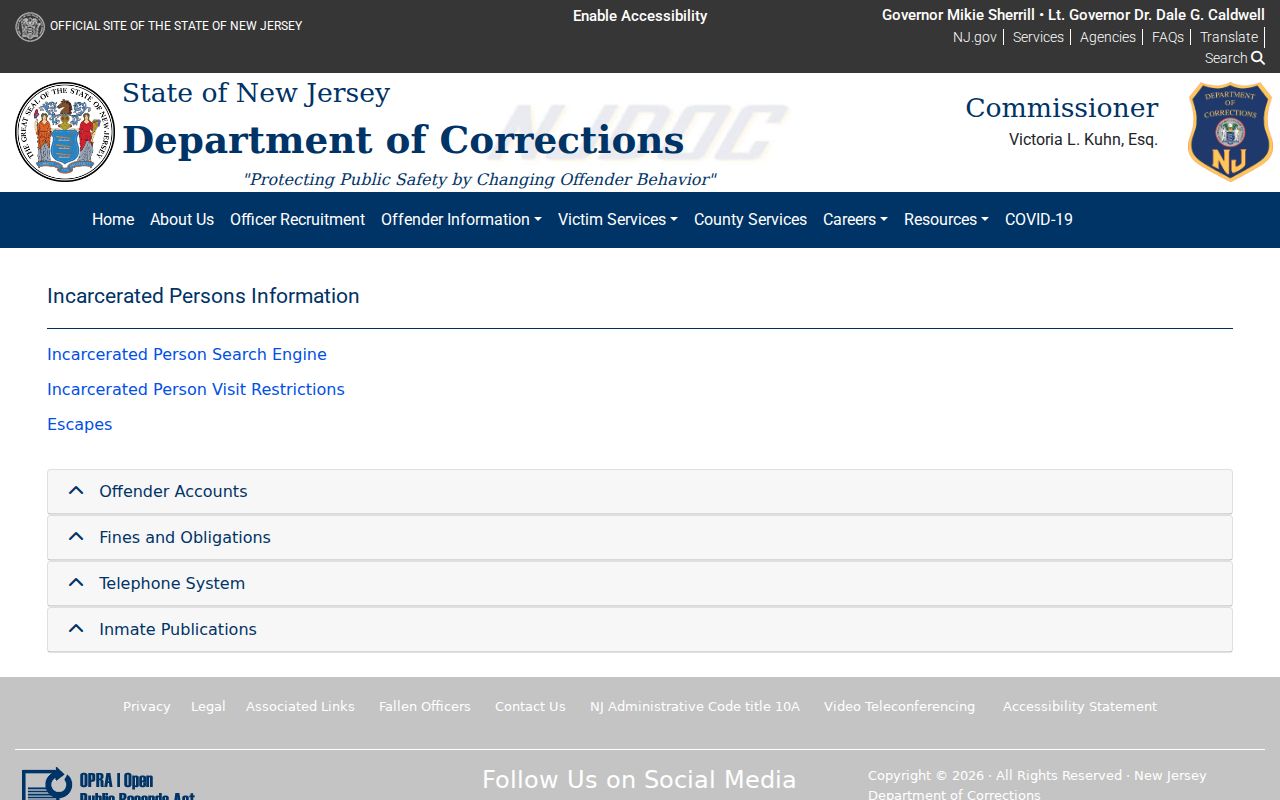
The displayed state route has a limited correctional-record purpose. The linked engine and fields did not render during the research inspection, so no specific search fields or result claims are made here.
The New Jersey State Police registry is shown below.
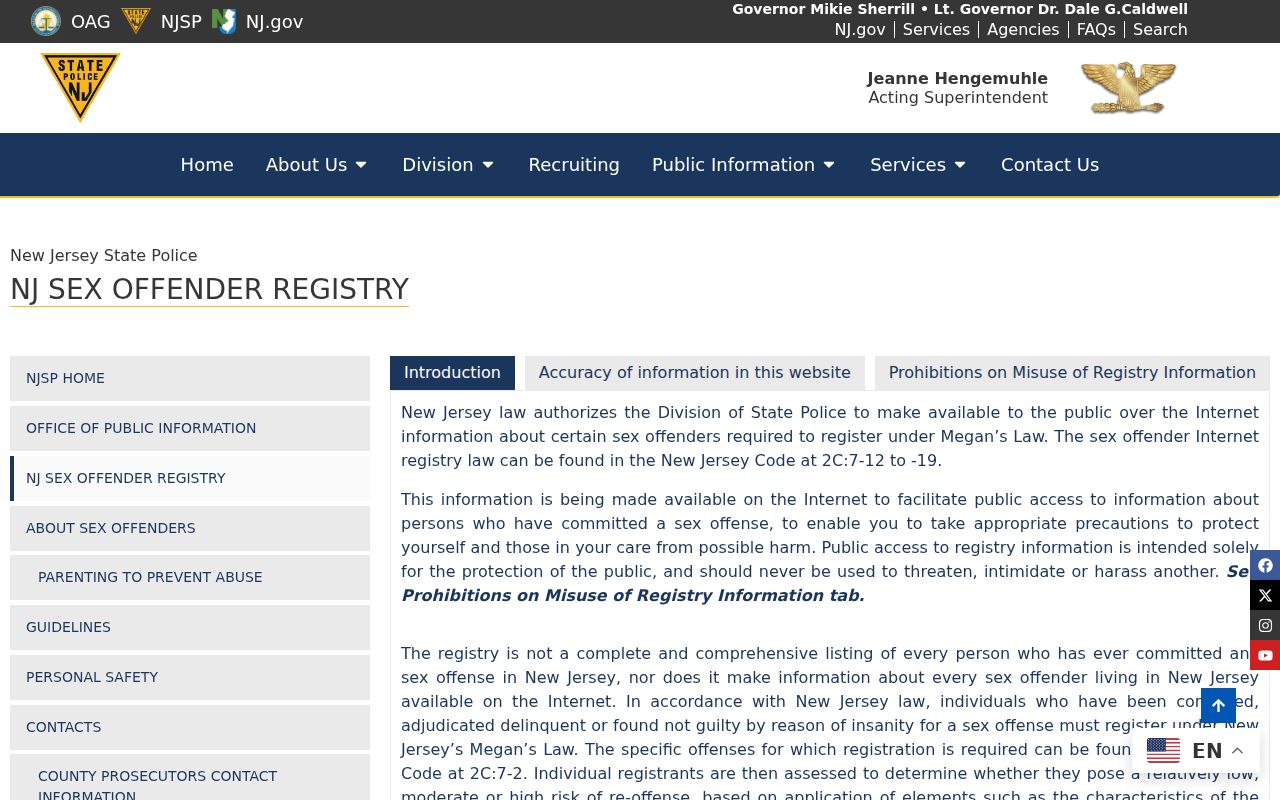
This registry has a public-safety purpose and its search fields did not render during inspection. It must not be repackaged as a broad name or address directory.
Request a Lyndhurst Resident Record
When no online record answers a defined question, use New Jersey's Open Public Records Act, or OPRA, for a specific government record. The Township Clerk is Lyndhurst's municipal custodian. The local form permits hand delivery, mail, and electronic transmission. Police, courts, and vital records can have their own custodians and special request routes, so OPRA does not bypass court rules or vital-record eligibility.
Use the Lyndhurst OPRA request form to name one document type, department, date range, and preferred format. The normal response period is seven business days for an available record, with special rules for storage, redaction, Daniel's Law review, and some other requests. Current state guidance lists $0.05 for a letter-size page and $0.07 for a legal-size page, while electronic records are generally free; extraordinary work can bring a special charge. The official OPRA explanation describes exemptions and appeal routes.
Note: A broad request for all residents is less useful than a precise request and may require clarification, redaction, or a cost estimate.
Lyndhurst Resident Lookup Privacy Boundaries
A blank, substituted, or omitted address is not a search error to solve. New Jersey's Address Confidentiality Program gives qualifying participants a legal substitute address and mail-forwarding service. It cannot erase all historic public records, but it protects a relocated participant's location and requires government agencies to accept the substitute legal address.
Daniel's Law also directs the Office of Information Privacy to redact protected home addresses and certain identifiers for covered people on government sites. NJGIN parcel data can therefore omit owner names. Do not triangulate a protected address from tax, voter, deed, court, map, or other records. The correct result is protected or unavailable, not unresolved data to reconstruct.
Lyndhurst Resident Lookup Use Limits
Use records only for a lawful, personal purpose such as family history, reconnecting with someone who has chosen to be found, estate research, or checking a public record with its custodian. Keep full dates of birth, signatures, Social Security numbers, driver identifiers, medical information, private contact details, and protected addresses out of research notes and any sharing. Public access to one field never authorizes collection of unrelated information.
Lawful use. A Lyndhurst resident lookup must never be used to stalk, harass, intimidate, or harm anyone. Respect every redaction and use the relevant custodian process to correct or clarify a record.